
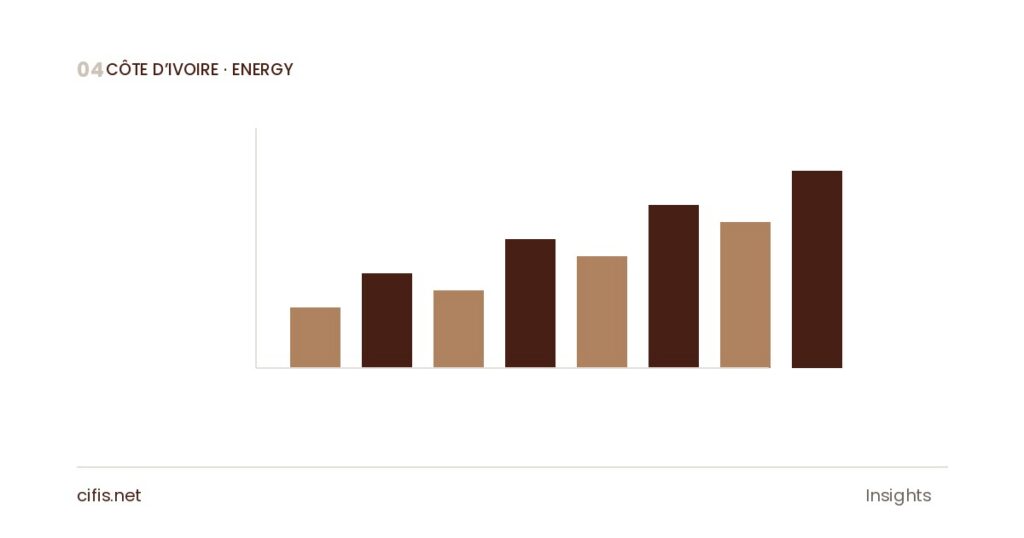
Côte d’Ivoire’s installed power capacity nearly tripled between 2011 and 2024, from 1,391 MW to about 3,019 MW. Today the mix is still dominated by thermal generation, mainly gas, at roughly 75%, with hydroelectric dams supplying most of the rest and solar still marginal.
What the renewables target hides
A government target is a policy statement, not a construction schedule. It does not tell you which plants in the pipeline have signed offtake agreements, secured land, or reached financial close. Before recommending a site, we verify the actual permitting and offtake status project by project, not the sector-wide target.
The target and the pipeline
- The government’s stated goal is 45% renewables in the electricity mix by 2030, with installed capacity expected to reach about 5,128 MW, up from 3,019 MW in 2024.
- Solar capacity is projected to jump from about 42 MW in 2026 to 925 MW by 2030, through a series of public-private solar plants (Korhogo, Poro Power, Boundiali, Kong, Katiola and others), several structured as 25-year build-own-operate-transfer agreements.
- On hydro, the Soubré dam (275 MW) has been operating since 2017; Gribo-Popoli (112 MW) is under construction, and a further pipeline of smaller dams is planned through 2030.
Why this matters beyond the power sector
A more reliable, more diversified grid supports every other sector an investor might target — industrial zones, agro-processing, logistics and housing all depend on it. Côte d’Ivoire’s electricity access and coverage targets are both set at 100% by 2030.
What to check before committing capital
Most of the solar pipeline runs through public-private partnerships with the state utility, CI-Energies, rather than open merchant markets. For an investor, that means the key diligence points are the credit quality of the offtake arrangement, the track record of the partner already selected for a given plant, and realistic delivery timelines — recent reporting has flagged gaps between new generation capacity and the state of the transmission network.
Disclaimer: this article is provided for general information and is not investment advice. Figures are as reported by the sources cited and may be revised.